
Cold Atmospheric Plasma (CAP) Jet System
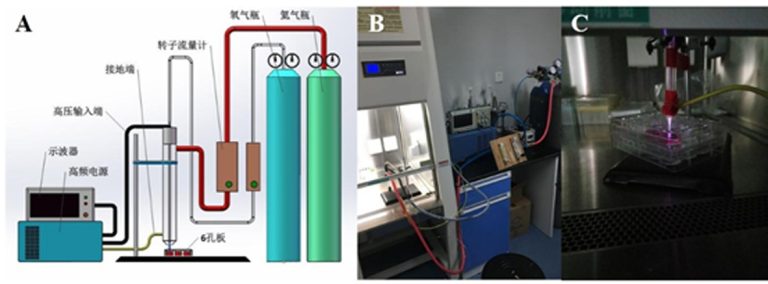
The Cold Atmospheric Plasma (CAP) Jet System is a non-contact, room-temperature plasma platform developed by Metathermo for biomedical research. Based on an improved dielectric barrier discharge (DBD) architecture and driven by a high-frequency AC power supply, the system uses high-purity helium to generate a stable, centimeter-long plasma jet at atmospheric pressure—without any vacuum environment. It supports both in vitro culture-medium activation (PAM) and in vivo tumor intervention via Metathermo’s proprietary intra-tissue needle. Validated by Jiangnan University Medical School, the platform significantly suppresses triple-negative breast cancer cells and inhibits tumor growth in bearing mice, making it a promising physical therapy tool for plasma medicine.
Product Image
Core Capabilities
- Improved DBD & Laminar Jet Discharge The reactor adopts a helical ground electrode with an inverted conical quartz tube. Optimized quartz flow and electrode structure lower ignition voltage (≤ 0.23 kV) and stabilize a filamentary-discharge-suppressed, laminar jet for safe biological contact.
- Metathermo Intra-Tissue Needle A proprietary dual-needle nested structure delivers plasma deep into tissue while venting reactive byproducts through the inter-needle gap. No extra exhaust incision is required, solving deep delivery and safe venting simultaneously.
- Truly Cold Atmospheric Plasma (CAP) The jet maintains ≤ 25 °C even after 5-min exposure at ≤ 0.6 kV. The quartz surface stays slightly warm, ensuring no burn risk for in vitro cell cultures and in vivo animal models.
- Human-Safe Electrical Boundary Validated via a human-impedance mock circuit: peak safety current ≤ 1.24 mA and mock-body voltage ≤ 1.83 V (far below the IEC 50 V limit), enabling compliant biomedical operation.
- In Vitro & In Vivo Ready • In vitro: 1.5 L/min He flow for plasma-activated medium (PAM) and cell suppression. • In vivo: ≤ 0.22 L/min for intratumoral CAP delivery in subcutaneous xenograft models.
- Controllable Active Species (OES-Characterized) Jet enriched with N₂, NOₓ, OH radicals, and He metastable atoms. Characterized by Mechelle ME5000 optical emission spectroscopy for mechanistic biochemistry.
- Validated Antitumor Efficacy & Ferroptosis Mechanism SUM149 triple-negative breast cancer survival drops to ~20% after 24 h PAM; intratumoral CAP suppresses tumor growth in Balb/c nude mice. Mechanism clarified via mitochondrial shrinkage, GPX4 down-regulation, and Fer-1 reversal (ferroptosis).
Key Specifications
| Item | Specification |
|---|---|
| Discharge structure | Improved DBD (helical ground electrode + inverted conical quartz tube) |
| Drive power | High-frequency AC supply (Suman CTP-2000K), 8.8 kHz |
| Working gas | High-purity helium (He) |
| Gas flow | In vitro: 1.5 L/min; In vivo: ≤ 0.22 L/min |
| Ignition voltage | ≤ 0.23 kV with Metathermo intra-tissue needle (≈ 50% lower than early version) |
| Jet length | ≥ 11 mm without needle; stable discharge maintained with needle attached |
| Jet temperature | ≤ 25 °C (5-min exposure at ≤ 0.6 kV) |
| Peak safety current | ≤ 1.24 mA through human-impedance mock circuit at 0.6 kV |
| Safety voltage | ≤ 1.83 V across mock body (IEC limit: 50 V) |
| Main active species | N₂, NOₓ, OH radicals, He metastable atoms |
| High-voltage module | Suman CTP-2000K high-frequency AC source |
| Discharge head | Quartz tube + tungsten steel HV electrode + helical copper ground electrode |
| Gas control | Precision flow meter, continuous He adjustment |
| Safety interface | Human-impedance mock circuit for real-time V/I monitoring |
Technical Highlights
- From “quasi-DBD” to True Safe DBD: electrode and quartz-flow optimization cut ignition voltage and stabilize laminar jet discharge
- Genuinely Cold Plasma: quartz surface only slightly warm after 30 min; core jet < 25 °C, no burn risk
- Metathermo Intra-Tissue Needle: solves the conflict between “deep plasma delivery” and “byproduct venting” with a dual-lumen design
- Validated Antitumor Efficacy: SUM149 TNBC survival dropped to ~20% after 24 h PAM; intratumoral CAP suppressed growth in Balb/c nude mice with normal body-weight gain
- Mechanism Clarified: Ferroptosis: mitochondrial shrinkage, reduced cristae, GPX4 down-regulation; ferroptosis inhibitor Fer-1 reverses killing
- OES-Characterized Chemistry: Mechelle ME5000 confirms NOₓ / OH abundance for biochemical mechanistic studies
Typical Applications
- In Vitro Cancer Research: PAM preparation, triple-negative breast cancer cell suppression, ferroptosis mechanism studies
- In Vivo Tumor Therapy: intratumoral CAP intervention in subcutaneous xenograft mice
- Plasma Medicine Mechanisms: ROS / lipid-peroxide dynamics, mitochondrial function, Western-blot analysis
- Safety Parameter Calibration: voltage / current / temperature boundary tests under human-impedance simulation
- Reactive Species Spectroscopy: OES quantification of NOₓ, OH, N₂, and He metastables
- Teaching & Demonstration: intuitive visualization of atmospheric cold-plasma discharge and biomedical potential