
Thermal Evaporation System
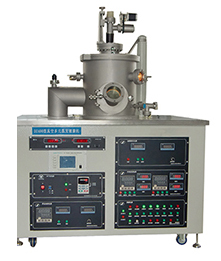
Thermal Evaporation System is an entry-level high-vacuum physical vapor deposition platform for universities, research institutes, and material laboratories. With a vertical bell-jar stainless steel chamber, the system evaporates metals and organic materials by resistive heating to deposit conductive metal films, semiconductor films, ferroelectric films, optical films, and organic small-molecule layers. It is the most common “first evaporation tool” for microelectronics, optoelectronics, 2D-material contacts, and teaching laboratories. Compared with electron beam evaporation, resistive evaporation has a simpler structure, lower cost, and a much gentler learning curve.
Product Image
Core Capabilities
-
Compact Vertical Bell-Jar Chamber
The coating chamber is Φ300 × H400 mm, made of single-wall stainless steel with a motorized lifting bell jar. It takes little floor space, opens quickly, and is easy to maintain—well suited to desktop labs and teaching platforms. -
Metal + Organic Dual-Evaporation Architecture
• 2 metal evaporation sources with water-cooled copper electrodes, 2 kW × 2 power supplies for controlled evaporation rate.
• 2 organic evaporation sources with quartz crucibles and adjustable temperature for thermally sensitive small molecules and organic semiconductors. -
Quartz Crystal Thickness Monitoring
A standard quartz crystal monitor covers 0.1 Å – 99 μm and provides real-time rate/thickness feedback, making even a teaching-grade evaporator capable of repeatable films. -
Simple Sample Stage for Fast Experiments
Holds four 30 × 30 mm substrates. The stage is non-heated and non-rotating but can move vertically toward/away from the sources—ideal for quick deposition, shadow-mask patterning, and contact-layer fabrication. -
High Vacuum, Low Contamination
Ultimate vacuum ≤5×10⁻⁵ Pa meets the basic residual-gas requirements of metal and organic films. Mechanical pump + turbo-molecular pump configuration can be selected based on budget and application. -
Low Barrier, Easy Maintenance
No high-voltage electron gun means simpler electronics. An independent control cabinet and straightforward workflow let students and new users get started quickly—an ideal low-cost entry point for laboratories beginning thin-film work.
Technical Specifications
| Item | Specification |
|---|---|
| Chamber Material and Size | Φ300 × H400 mm, vertical bell jar, all stainless steel |
| Chamber Opening | Motorized bell-jar lift |
| Metal Sources | 2 sets, water-cooled copper electrodes |
| Organic Sources | 2 sets, quartz crucibles, temperature-controllable |
| Source Power | 2 kW × 2 |
| Substrate Size | 30 × 30 mm, 4 pieces per run |
| Sample Motion | Non-heated, non-rotating, vertical lift only |
| Thickness Monitor | Quartz crystal monitor, 0.1 Å – 99 μm |
| Ultimate Vacuum | 5×10⁻⁵ Pa |
| Vacuum Measurement | Ionization gauge + Pirani/resistance gauge |
| Vacuum System | Mechanical pump + turbo pump (configurable) |
| Power Supply | AC 380 V, 50 Hz, 8 kW |
| Main Unit Size | 1000 × 850 mm |
| Weight | Approx. 200 kg |
Typical Applications
- Microelectronics & Devices: Au/Ag/Cr/Ti electrodes, pads, leads, shadow-mask patterns
- Optoelectronics: OLED/OPV organic functional layers, hole/electron transport layer patterning
- 2D Materials: Metal contacts for graphene/hBN devices, back-gate electrodes, post-transfer layer repair
- Semiconductors & Ferroelectrics: metal–semiconductor contacts, ferroelectric/dielectric film pre-study
- Teaching & Platform Use: Undergraduate labs, graduation projects, first evaporator for new research groups