
FDTR

FDTR Thermal Conductivity Measurement System

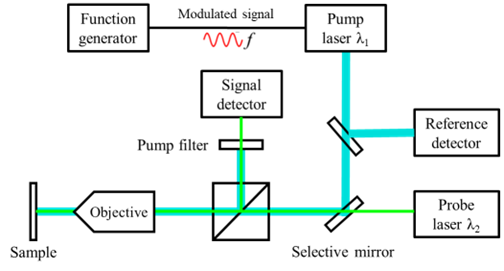
Frequency-Domain Thermoreflectance (FDTR) thermal conductivity measurement system, independently developed by Metathermo (Suzhou) Energy Technology Co., Ltd., is a non-contact, micro/nanoscale thermophysical property characterization platform based on the optothermal detection principle. The system employs two laser beams (pump + probe) to excite and detect periodic temperature rise signals on the surface of a metal transducer/sample. By extracting the variation of thermoreflectance with modulation frequency, it derives the thermal conductivity, thermal diffusivity, and interfacial thermal resistance of the material. Covering a wide range of testing requirements from thin films and bulk materials to micro/nanoscale heterostructures, the system is well suited for research on thermal management materials, 2D electronic devices, thermoelectric materials, and low-dimensional physics.

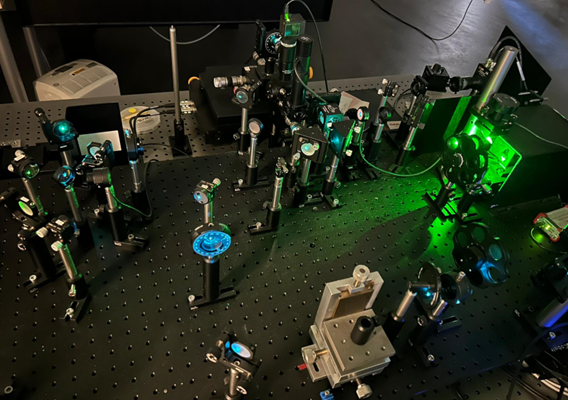
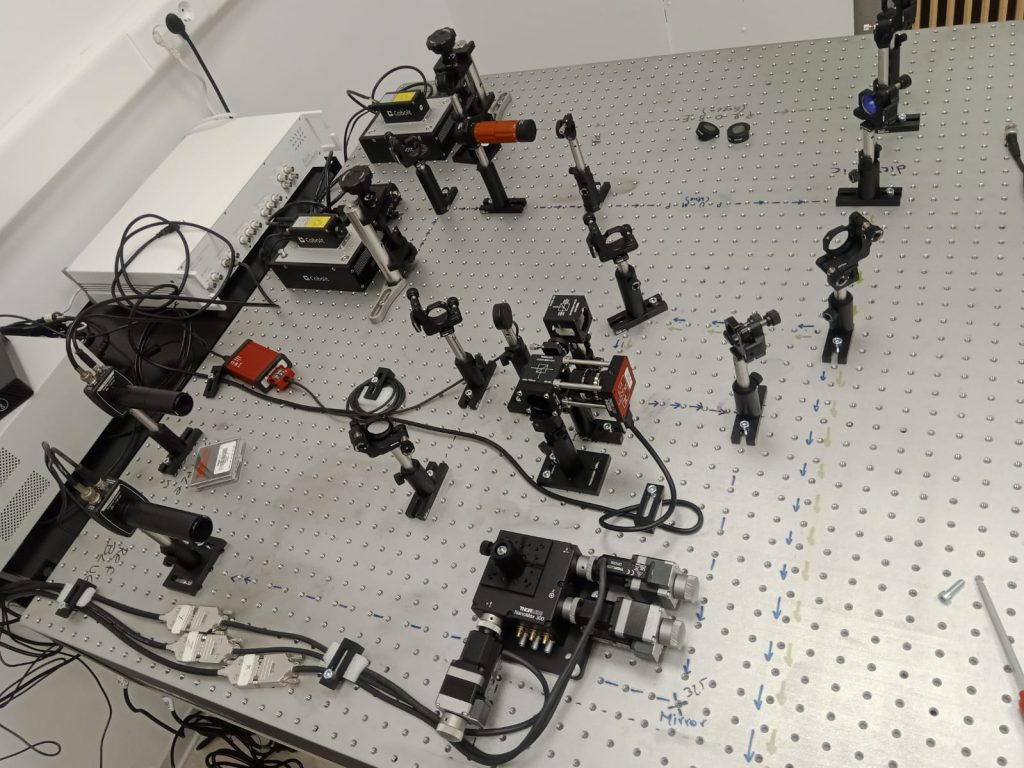
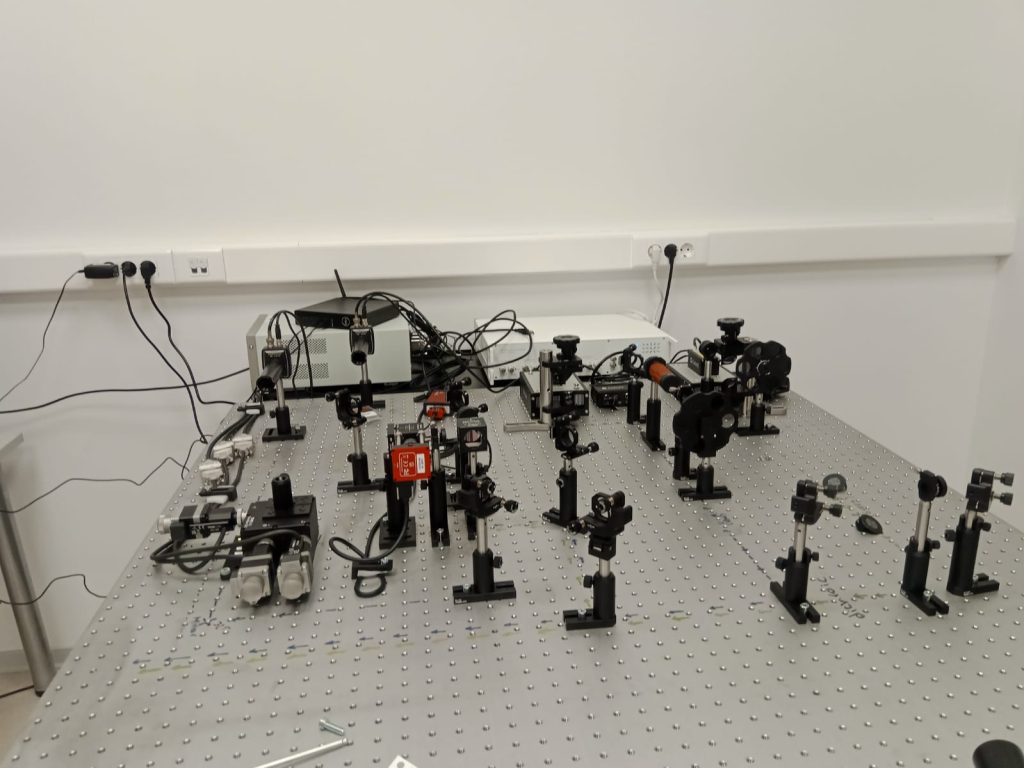
System Photo

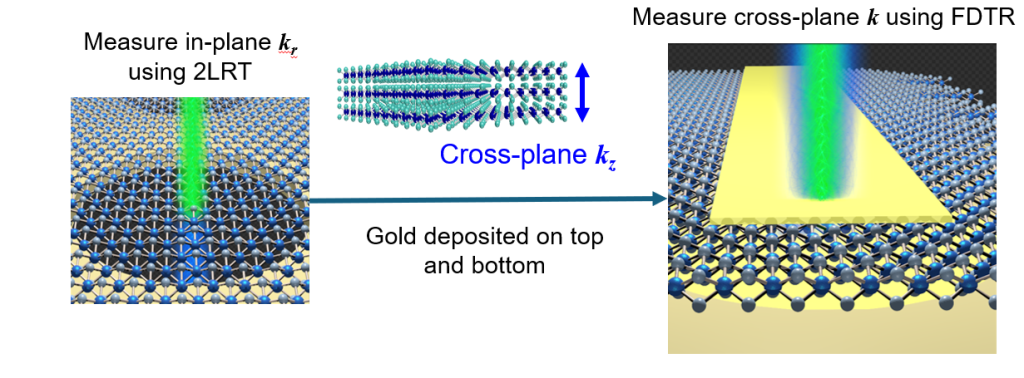
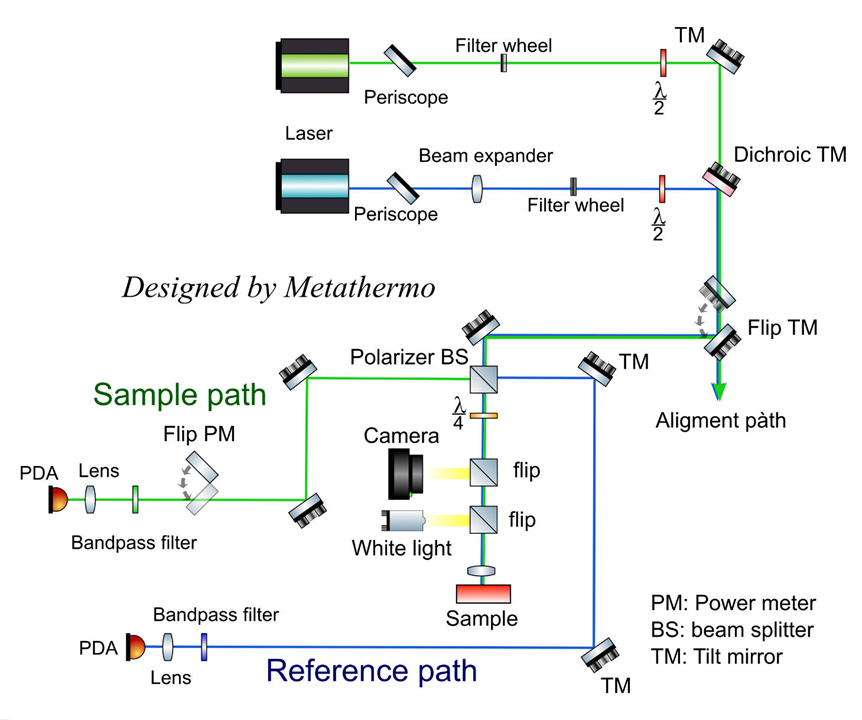
Working Principle

Key Performance Parameters

Item Specification
Measurement Mode Frequency Domain Thermoreflectance (FDTR), single / dual wavelength optional
Pump Laser Modulation Frequency Range Typical 10 kHz – 20 MHz (continuous frequency sweep)
Thermal Conductivity Measurement Range ~0.1 – 2000 W/(m·K) (depends on sample structure and fitting model)
Thermal Diffusivity Measurement Range 10⁻⁸ – 10⁻⁴ m²/s
Spatial Resolution Optical diffraction limit, typical spot size ~5–10 μm (sub-micron achievable with objective lens)
Temperature Range Room temperature – 500 °C (low / high-temperature sample stage extension optional)
Interface Thermal Resistance Sensitivity Resolvable down to ~10⁻⁸ m²·K/W level
Sample Requirements Metal transducer layer (Al / Au / Pt, etc.) or sufficient thermoreflectance on surface
Data Acquisition Lock-in amplifier real-time demodulation of 1ω/2ω signals, auto frequency sweep + fitting
Control Software Integrated optical alignment, frequency sweep, parameter inversion and report generation

System Components

ModuleDescription
Optical EngineCW pump laser + probe laser; acousto-optic / electro-optic modulator for frequency modulation
Microscopic Optical PathCoaxial incidence, high-NA objective lens focusing; confocal design ensures signal collection efficiency
Motion & PositioningHigh-precision motorized XYZ stage, nanometer stepping, supports multi-point array scanning
Signal DetectionPhotodetector + lock-in amplifier to extract weak 2ω thermoreflectance signal
Environmental ControlOptional nitrogen purge chamber or vacuum sample cell to suppress convection and oxidation
Analysis SoftwareBuilt-in multi-layer heat conduction model (including interface thermal resistance); one-click fitting to output κ, α, R_th

Technical Highlights

🔬 Non-contact, Non-destructive Measurement

No microfabricated electrodes or temperature sensors need to be fabricated on samples. Thermal properties are obtained purely via optical probing, making it especially suitable for delicate thin films, 2D material heterostructures, micro/nano devices and other samples incompatible with conventional 3ω or TTR processes.

📊 Full-spectrum Thermal Response Analysis

Continuous frequency sweeps yield complete curves of thermoreflectance phase/amplitude versus modulation frequency. A single measurement can simultaneously extract bulk thermal conductivity, thermal diffusivity and interface thermal resistance, delivering far richer information than single-point steady-state methods.

🎯 Micro-area Mapping Capability

Paired with a motorized stage, 2D thermal conductivity distribution scanning can be performed across the sample surface to visualize spatial variations in material uniformity, defect distribution or interfacial bonding quality.

🔗 Complementary to the 3-Omega Platform

MetaThermo offers both 3-Omega and FDTR systems. The 3-Omega method excels at rapid measurements for bulk solids / liquids / irregular surfaces, while FDTR specializes in high-resolution characterization of micro-nano thin films and interfaces. Combined, they support full-scale thermal property research from macroscopic down to atomic scales.

🧪 Validated for Cutting-edge Research

FDTR is widely adopted for thermal transport characterization of 2D materials including graphene, hBN and TMDCs, as well as interface thermal resistance analysis for phase-change memory, thermal interface materials (TIM), polymer composites and related fields.
Typical Applications

  • 2D Materials & Van der Waals Heterostructures: in-plane / out-of-plane thermal conductivity of monolayer / few-layer graphene, MoS₂, WSe₂
  • Chip Thermal Management: thermal resistance and thermal conductivity of thermal interface materials (TIM), underfill, thermal grease
  • Thermoelectric Materials: separation of in-plane thermal diffusivity and lattice thermal conductivity for thin-film thermoelectric legs
  • Energy Devices: microscale thermal properties of solid-state battery electrolytes and charge transport layers in perovskite solar cells
  • Functional Coatings: joint extraction of thickness and thermal conductivity for DLC, TBC (thermal barrier coatings), and CVD diamond films
  • Fundamental Physics: phonon transport, interfacial phonon coupling, and size-effect modulation of thermal conduction

Cooperation Cases

System installed for Greek collaborators
Schematic of the system installed in Greece

Related References

滚动至顶部